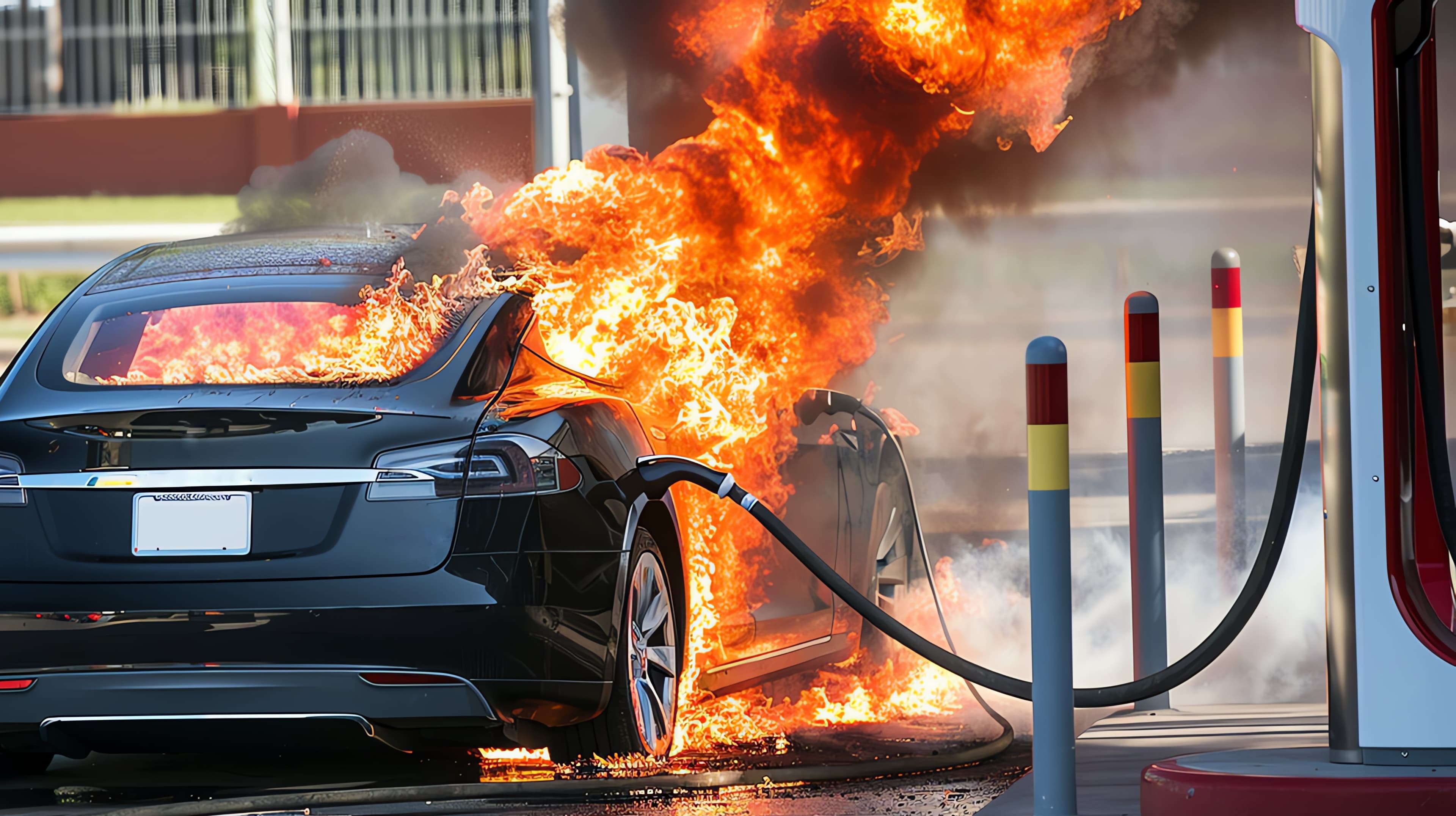
It is important to state from the beginning that ISO 3941 is not a mandatory requirement, and changes nothing other than to acknowledge that lithium-ion fires need to be considered as a different type of fire. Why is this important? This is important because additional hazards and risks need to be considered.
Lithium-ion battery fires are different because they don’t conform to the known and accepted strategies for extinguishing fire. The common and best-known description of extinguishing a fire is the ‘Fire Triangle’, fuel, oxygen and heat. Remove any one of the three elements of a fire, and the fire will be extinguished.
Lithium-ion battery fires are extremely difficult to deal with, even for fully trained personnel such as the UK’s professional Fire and Rescue Services. Lithium-ion battery fires will generate toxic fumes from the burning electrolyte such as hydrogen fluoride and phosphoryl fluoride and are not the type of fires that should be tackled by the general public. In case of any fire, call 999 and report the fire. If the fire is outside in the open, move to a safe distance and if the fire is in a building, get out and stay out.
Other classifications of fuel such as Class A, B, C, D, E, and F (K), all conform to conventional extinguishing principles. This new classification in ISO 3941 for lithium-ion fire does not. In the case of lithium-ion battery fires it would be prudent to remember that size matters. A single cell lithium-ion battery found in a phone is very different from a lithium-ion battery pack containing multiple cells. In certain conditions, multiple cells associated with larger lithium-ion batteries can enter a phase known as ‘thermal runaway’. This is a point at which a burning cell generates so much heat and energy it ignites the adjoining cell which creates more heat, and oxygen promoting the spread of fire to adjacent cells.
Lithium-ion batteries are constructed using multiple layers of connected single cells known as packs. These multiple cells/packs are completely incased by a ridged plastic or a steel body, with no direct access to individual cells or packs. This makes it impossible to apply a coolant directly to a burning cell or pack which is confined within that casing.
Lithium-ion battery fires are very different from any other type of fire.
A typical example of a larger battery used every day is a lithium-ion car battery. This is a battery made up of many single cells. A single cell in a lithium-ion battery used in a car would look like a CD case. These cells are closely stacked and connected into a pack, and there will be multiple packs to provide the power required in a battery of this size. These packs of cells are then enclosed into a steel case. This steel battery case is then surrounded by a car. How difficult do you think it would be to apply any form of cooling media to a burning lithium-ion cell or pack embedded in the floor of a car? There have been several incidents where a car, powered by a lithium-ion battery, has continued to burn whilst being fully submerged in water, such as a flowing river. This is evidence confirming conventional firefighting principles don’t apply to lithium-ion battery fires.
3FFF welcome the classification of Class L in ISO 3941 for the purpose of hazard identification. We would not welcome the narrative that there is a conventional answer to extinguishing this type of fire utilizing conventional extinguishing equipment and extinguishing media such as firefighting foam, water additives, dry powder or inert gases.
We belong to an innovative industry, so we are confident there will be an answer in the future, but it does not exist today. Creating product performance standards and protocols that are based on lithium-ion cells being open and accessible to a cooling media is not representative of how this type of fuel is presented when it is burning. A lithium-ion battery is an enclosed structure; it is not an openly exposed fuel.
As a firefighting chemical manufacturer, we understand that the chemistry of a lithium-ion fire reaction does not allow for a successful firefighting attack in a conventional manner. Any answer to safely dealing with lithium-ion battery fires will not be based on a conventional approach, using conventional firefighting equipment. At 3FFF we believe the innovation will need to be based on fire prevention rather than fire extinction, and certainly not based on poorly perceived protocols that do not properly address the nature of the fuel or how that fuel is stored.
Gary McDowall
3FFF Limited.
Related reading
-1.png&w=3840&q=75)
British Fire Consortium AGM: A Look Back at Our 150th Meeting On the 2nd of October, members of the British Fire Consortium gathered at Macdonald Old England Hotel & Spa Windermere for this year's AGM, which also marked our 150th meeting. Here's a look back at the day
For someone starting out in the fire and security industry, there is a lot to learn.
On 2 October 2026, BFC members will gather for this year's AGM, marking a milestone: the 150th meeting. To mark the occasion, we sat down with Graham Newman, BFC President a long-serving member, to trace the story from a conversation in a London hotel bar in the 1980s to the 240+ member organisation